Sixers Target Early Season Continuity Against Cavaliers
Opening Night Momentum Sets the Stage
The Philadelphia 76ers arrive at Xfinity Mobile Arena carrying undeniable structural confidence following a decisive season-opening victory over the defending champion New York Knicks. Scheduled for 7 p.m. ET on ESPN, Thursday’s matchup features Philadelphia as a 59 percent favorite, a valuation rooted in their immediate on-court synchronization and defensive discipline. The Sixers did not merely secure a win; they established a tactical blueprint that emphasizes rotational balance, perimeter spacing, and controlled tempo. Their ability to execute complex offensive sets against a premier defensive program suggests the franchise is operating well ahead of typical early-season adjustment curves.
Defensive Metrics and Possession Control
New York was held to exactly 100 total points in the opener, a figure that reflects Philadelphia’s commitment to half-court containment and transition denial. Advanced possession tracking reveals the profound impact of Joel Embiid’s minutes: the Knicks generated just 85 points per 100 possessions when Embiid remained on the floor, a number that escalated sharply to 126 once he exited. This differential highlights how Philadelphia’s defensive architecture functions as a force multiplier when anchored by their starting center. Beyond interior protection, the Sixers demonstrated elite rotational communication, forcing New York into contested jumpers and limiting high-value paint touches. The combination of rim protection and perimeter closeouts establishes a foundation that Cleveland will struggle to dismantle without significant schematic adjustments.
Interior Availability and Paint Dynamics
Cleveland’s game plan faces a critical variable regarding Jarrett Allen, who is listed as questionable due to a knee concern. Allen’s participation dictates whether the Cavaliers can establish reliable screen-and-roll action and control offensive rebounding positioning. If Allen sits, Philadelphia gains a pronounced advantage in the restricted area and on the glass. Embiid’s ability to draw double teams, absorb contact, and finish through traffic would face minimal resistance from a compromised interior presence. Without Allen’s screening and lob finishing, Cleveland’s offensive geometry becomes predictable, forcing them to rely more heavily on isolation plays and perimeter creation. This shift exposes the Cavaliers to faster-paced transition sequences where Philadelphia’s defensive rebounding and outlet passing excel.
Perimeter Volume and Defensive Vulnerabilities
Tyrese Maxey began the campaign with a difficult shooting display, converting just two of nine attempts from beyond the arc. However, his long-range profile demands continuous attention from opposing guards. Last season, Maxey averaged 3.1 made three-pointers on 8.6 attempts per contest, establishing himself as a high-volume shooter who consistently attacks closeout lapses. Cleveland’s perimeter defense has shown measurable susceptibility to guard-driven spacing. During the 2025-26 season, opposing point guards averaged 2.7 three-point attempts against the Cavaliers, indicating a pattern of yielding outside space on switch-heavy schemes. Maxey’s historical volume and efficiency suggest he will exploit these gaps, particularly if Cleveland’s weak-side rotation fails to recover quickly enough to contest catch-and-shoot situations.
Facilitation Shifts and Playmaking Distribution
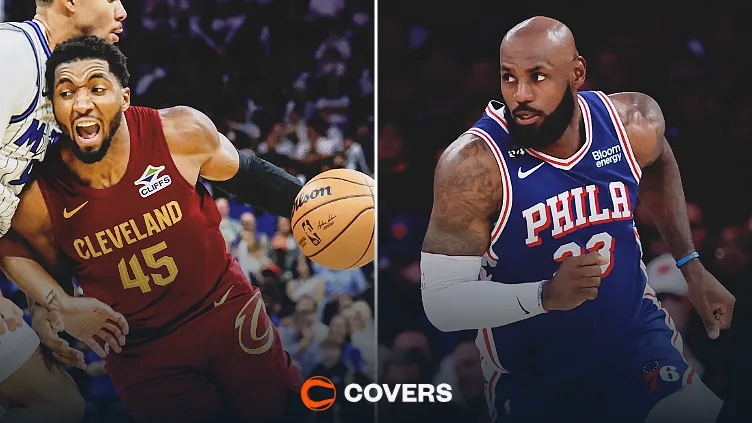
Philadelphia’s offensive identity has visibly expanded beyond traditional post-centric scoring. Embiid recorded six assists against New York, continuing a deliberate progression toward elevated playmaking responsibilities. Historically, he has averaged slightly under 3.5 assists per contest when facing Cleveland, but his current role prioritizes creating open looks for teammates rather than forcing low-percentage isolation finishes. This facilitation evolution pairs seamlessly with LeBron James, who operates as a secondary orchestrator for the Sixers’ starting lineup. James delivered a team-high seven assists during a notable road appearance at Madison Square Garden and finished the previous campaign averaging 7.2 assists per game. His ranking as 17th among qualified players in potential assists underscores his elite vision and willingness to distribute. With Jaylen Brown, VJ Edgecombe, Maxey, and Embiid all capable of finishing plays, James’s court generalship should generate high-efficiency looks, making an eight-assist performance a statistically sound projection.
Cleveland’s Primary Scoring Engine
Despite Philadelphia’s systemic advantages, Cleveland possesses a proven offensive weapon capable of dismantling their scheme. Donovan Mitchell remains the Cavaliers’ central scoring hub and has historically thrived against Philadelphia. Over four career meetings with the Sixers, Mitchell averaged 27.8 points per game, demonstrating a complete three-level scoring repertoire that includes mid-range pull-ups, rim attacks, and catch-and-shoot precision. His comfort against Philadelphia’s defensive rotations ensures he will remain unfazed by physical pressure or switching assignments. Even with James Harden sharing the backcourt, Mitchell maintained the highest usage rate on the roster, averaging 26 points on 18.6 shot attempts per game during their prior tenure together. This sustained offensive burden indicates Cleveland will lean heavily on Mitchell to counteract Philadelphia’s balanced attack and create separation during fourth-quarter stretches.
Market Indicators and Strategic Outlook
Betting markets and proprietary tracking models consistently highlight Philadelphia’s reliability in covering moneyline expectations. The Sixers have successfully cashed on the moneyline in 25 of their last 45 contests, generating a tracked return of plus-16.95 units and delivering a 17 percent return on investment. These figures reflect a sustainable edge rather than short-term variance, reinforcing confidence in their current form. Market sentiment platforms like Polymarket currently mirror these probabilities, suggesting institutional and retail capital aligns with Philadelphia’s championship-caliber blueprint. Analysts emphasize that while Cleveland’s perimeter scoring and transition defense could keep the contest competitive, Philadelphia’s starting five cohesion, interior dominance, and playmaking depth position them to control the closing minutes. For observers tracking advanced metrics and line movement, this matchup offers a compelling early-season test of championship aspirations versus veteran resilience. Responsible wagering frameworks advise monitoring late injury reports and starting confirmations before finalizing projections, as real-time data frequently shifts pre-game probabilities.
Source Reference (covers.com): Cavaliers vs 76ers Prediction, Top Picks & Best Bet for Tonight's NBA Game