October Holiday Divide Deepens Across U.S. Jurisdictions
A National Calendar Fractured by Historical Memory
Americans mark the second Monday of October under markedly different banners depending on their geographic location. As the nation navigates October 12, a clear geographical fault line has emerged regarding how the country commemorates its past. While the federal government maintains Columbus Day as a statutory holiday, an increasing number of jurisdictions are pivoting toward Indigenous Peoples’ Day, reflecting a prolonged cultural and political reckoning over national memory.
The Legal Baseline Versus State Implementation
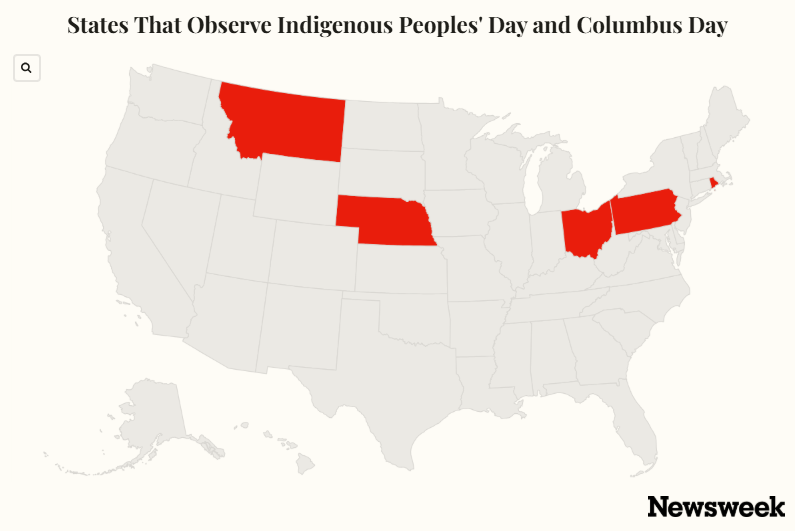
Under current United States code, the second Monday of October remains legally designated as Columbus Day. This federal designation carries concrete operational weight: federal buildings shutter, the U.S. Postal Service suspends deliveries, and Federal Reserve institutions close their doors. Yet the statutory mandate exists in tension with evolving state policies. According to data compiled by the Pew Research Center, thirty states and three U.S. territories acknowledge Columbus Day in some capacity, though only twenty grant it as a compensated day off for public sector workers. Conversely, seventeen states alongside Washington, D.C., formally observe Indigenous Peoples’ Day on the same date. The financial dimension reveals an even starker divide; merely five jurisdictions—Montana, Nebraska, Ohio, Pennsylvania, and Rhode Island—provide paid leave for Indigenous observances while simultaneously honoring Columbus. Alabama further complicates the matrix by maintaining both Columbus Day and American Indian Heritage Day as compensated holidays.
A Three-Tiered Administrative Framework
The landscape of October observances fractures into three distinct administrative models. The first tier comprises four jurisdictions that have entirely supplanted the traditional maritime commemoration with a dedicated Indigenous holiday. Maine, New Mexico, and Vermont enacted these replacements in 2019, while South Dakota pioneered the approach decades earlier by instituting Native American Day in 1990. The second tier encompasses the aforementioned five states that grant paid recognition to Indigenous communities without displacing Columbus Day. A third category includes seven additional states that officially acknowledge Indigenous presence on the calendar but decline to convert the observance into compensated time off for state personnel. This patchwork arrangement ensures that a single national date yields vastly different workplace realities depending on jurisdictional boundaries.
Executive Rhetoric and Political Positioning
The shifting nomenclature has drawn direct commentary from the highest levels of executive leadership. In 2021, President Joe Biden issued the inaugural presidential proclamation recognizing Indigenous Peoples’ Day, establishing a historic precedent without altering existing legislation. His statement emphasized national unity and historical accountability, noting that the observance celebrates the enduring contributions and resilience of Native populations, affirms their inherent sovereign status, and reinforces the federal government’s binding treaty commitments to Tribal Nations. On Indigenous Peoples’ Day, our Nation celebrates the invaluable contributions and resilience of Indigenous peoples, recognizes their inherent sovereignty, and commits to honoring the Federal Government’s trust and treaty obligations to Tribal Nations.
By contrast, President Donald Trump recently released a formal proclamation defending the traditional October designation. His address framed the commemoration around themes of exploration and national triumph, asserting that the republic’s foundational freedoms stem from Columbus’s unwavering dedication. He explicitly warned against efforts to dismantle his historical narrative, declaring that the administration would never permit the figure’s legacy to be dismantled by what he characterized as radical ideological campaigns. Today, we honor his life of valor, adventure, and ingenuity. We cherish his memory and pledge to safeguard his story. Above all, we remember with gratitude that the triumph of freedom and the glory of our Republic are the fruits of his faith and unrelenting devotion.
Roots of a Decades-Long Movement
The trajectory toward October Indigenous recognition predates modern political maneuvering by several decades. International discourse first crystallized during a 1977 United Nations conference in Geneva focused on combating discrimination against Indigenous populations, where scholars and activists proposed replacing the existing October holiday with one centered on Native histories. Domestic implementation followed slowly. South Dakota’s 1990 transition to Native American Day marked the first statewide adoption. Sixteen years later, Berkeley, California, became the pioneering municipality in the nation to formally establish Indigenous Peoples’ Day in 1992, deliberately timing the move to coincide with the quincentennial of Christopher Columbus’s initial transatlantic crossing.
The Philosophical Friction Shaping Public Discourse
The ideological friction driving these changes remains acute. Proponents of the traditional holiday emphasize the profound cultural significance of Christopher Columbus to Italian-American communities, viewing the date as a vital anchor for ethnic heritage and immigrant narratives. Advocates for the Indigenous alternative argue that the conventional observance systematically marginalizes the millions of Native peoples who inhabited the continent prior to European contact, while obscuring the severe demographic, territorial, and cultural disruptions triggered by colonization. Paul Chaat Smith, a Comanche writer and curator at the Smithsonian Institution’s National Museum of the American Indian, has consistently articulated this perspective, previously stating that The most American thing about America is American Indians.
Operational Realities and Legislative Outlook
Despite the vocal exchange between competing historical frameworks, the practical impact on daily operations remains geographically constrained. Federal mandates ensure that October 12 functions as a standard closure day for government agencies, banking institutions, and postal networks nationwide. Educational calendars, however, operate independently; public school districts lack a uniform federal directive, leaving superintendents to determine whether classrooms remain open or close based on municipal policy. Private enterprises similarly retain autonomy over staffing schedules. The legislative architecture shows little sign of immediate alteration. Congress retains the authority to modify federal holiday statutes, yet no bipartisan consensus currently exists to replace or rename the October designation. Consequently, the divergence between federal law and state practice will likely persist, with individual legislatures continuing to calibrate their own commemorative calendars. As demographic shifts and renewed emphasis on historical accuracy reshape public discourse, the October holiday will remain a focal point for negotiations over whose stories receive official recognition and how the nation chooses to memorialize its complex past.
Source Reference (newsweek.com): Map Shows States That Observe Indigenous Peoples’ Day and Columbus Day