Federal Court Dismisses Capitol Police Plaque Lawsuit
In the realm of American jurisprudence, few disputes rest so heavily on the intangible demands of honor as the recent litigation concerning the United States Capitol’s January 6 memorial. For Metropolitan Police officer Daniel Hodges and former U.S. Capitol Police officer Harry Dunn, the objective was never financial restitution or regulatory reform; it was a fundamental demand for tangible acknowledgment. That pursuit reached its conclusion Wednesday when U.S. District Judge Dabney Friedrich issued a definitive ruling, dismissing the officers’ lawsuit over the exclusion of their names from the commemorative plaque honoring first responders who confronted the insurrection. The dismissal, anchored in a procedural determination of lacking jurisdiction, closes the file on the case without addressing the underlying merits, leaving the monument’s design and placement intact.
The Verdict and the Architects of the Dispute
Judge Friedrich, a Trump appointee serving the District of Columbia, granted the motion to dismiss filed by the Architect of the Capitol, the federal agency responsible for the maintenance and operation of the Capitol complex. The ruling centers on the doctrine of Article III standing, a threshold requirement that prevents courts from adjudicating grievances that do not meet strict legal criteria for injury. By invoking this procedural barrier, the judge effectively neutralized the officers’ claims, establishing that emotional distress and perceived symbolic slights do not automatically confer the judicial authority necessary to compel government modification of a memorial. The Architect, as the respondent, faced scrutiny over its execution of congressional directives, but the court’s focus remained on whether the plaintiffs possessed the legal right to sue at all.
Anatomy of the Memorial Conflict
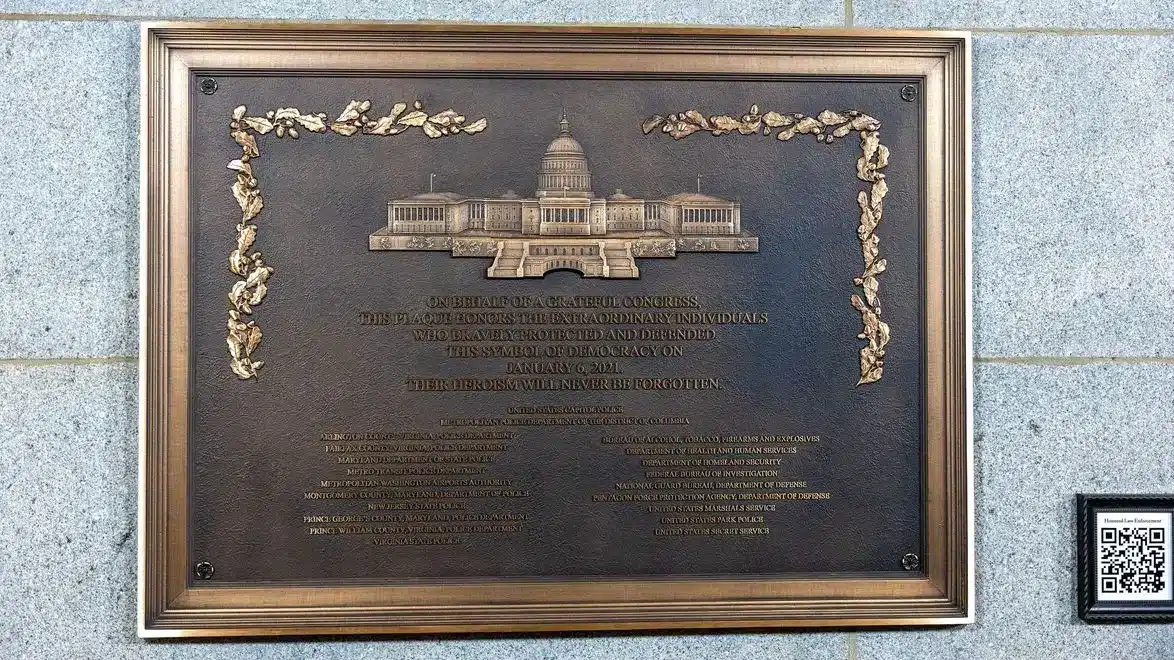
The plaque itself stands as the epicenter of the controversy. Inscribed with the text, “On behalf of a grateful Congress, this plaque honors the extraordinary individuals who bravely protected and defended this symbol of democracy on January 6, 2021. Their heroism will never be forgotten,” the monument projects an aura of permanence and reverence. However, the physical realization of this sentiment diverged from the expectations harbored by some of those recognized. The design lists the law enforcement agencies and organizations that dispatched personnel to the Capitol rather than enumerating individual names on the face of the structure. Instead, the memorial incorporates a QR code, enabling visitors to scan for digital access to a comprehensive roster of officers. Hodges and Dunn argued that this format failed to deliver the direct, individual recognition implied by the legislation’s spirit, contending that reducing their service to an agency designation alongside a scannable link diminished the personal sacrifice made during the breach.
Chronology of Delays and Relocation Battles
The friction between the officers and the Architect traces back to a timeline punctuated by statutory mandates and administrative pacing. President Joe Biden signed legislation in 2022 authorizing the plaque’s creation, imposing a strict one-year deadline for its installation. As that window expired, the project remained incomplete, coinciding with a shift in congressional power wherein Republicans assumed control of the House. The plaque was finally installed in March following a cumulative three-year delay, a lag that intensified frustration among the plaintiff officers. Once erected, the dispute pivoted from existence to geography. The original vision stipulated that the memorial reside permanently on the western front of the Capitol, a location selected for maximum public visibility. Authorities ultimately positioned the plaque within the non-public Senate wing. Hodges and Dunn asserted this relocation effectively concealed the tribute from the general populace, rendering the act of commemoration hollow by restricting access to a secure, internal area.
Judicial Analysis of Standing and Redressability
Judge Friedrich’s decision hinged on the technical assessment of standing at the moment the complaint was filed. The court determined that neither officer could demonstrate a cognizable injury concurrent with the plaque’s actual installation. The plaintiffs attempted to frame their grievance around “psychic injuries” sustained since January 6, 2021, which they argued were exacerbated by what they viewed as inadequate recognition. They further alleged that the omission of individual names emboldened third parties to harass them and disparage their conduct during the riot. This claim sought to broaden the scope of harm beyond symbolism to tangible social consequences, suggesting the memorial’s design validated critics and exposed officers to ongoing hostility. However, Friedrich rejected the proposition that these subjective harms satisfied the jurisdictional requirements. “To be sure, the officers have a far more personal connection to the plaque than the public at large,” Friedrich wrote, acknowledging the unique bond between the government and the very officers Congress intended to honor. “They are not ‘just any person,’ they are among the very officers Congress sought to honor.” Despite validating the depth of the officers’ interest, the court drew a firm line between personal significance and legal redress. “Article III standing is not measured by the intensity of the litigant’s interest,” the ruling continued, emphasizing that the officers needed to prove that a court order mandating the removal or redesign of the plaque would likely alleviate their purported injuries—a causal link the court found insufficient. The judge noted that even if the delay contributed to the officers’ sense of injury, there was no evidence that forcing the Architect to alter the plaque’s location or content would cure those feelings.
Finality and the State of the Monument
With the dismissal, the legal avenue through which Hodges and Dunn sought to alter the memorial’s presentation has been exhausted. The ruling preserves the status quo, allowing the plaque to remain in the Senate wing with its current design featuring agency listings and a digital QR index. For the officers, the decision represents a frustrating closure to a campaign that prioritized the form and substance of official recognition over monetary compensation. The case underscores the rigorous barriers erected by the federal judiciary to prevent courts from becoming arbiters of grievances rooted primarily in emotional or symbolic dissatisfaction, even when those grievances involve high-profile events like the attack on the Capitol. As the legal fight concludes, the monument stands as a permanent fixture of the Capitol grounds, its placement and content untouched by the challenge mounted by the men it was designed to commemorate.
Source Reference (usaherald.com): Capitol Police Plaque Lawsuit Dismissal Ends Officers’ Legal Fight
Frequently Asked Questions (FAQ)
Why was the Capitol Police plaque lawsuit dismissed?
U.S. District Judge Dabney Friedrich dismissed the lawsuit for lack of jurisdiction because the officers failed to demonstrate sufficient legal standing or a cognizable injury in fact at the time of filing.
Who are the plaintiffs in the lawsuit?
The plaintiffs are Metropolitan Police officer Daniel Hodges and former U.S. Capitol Police officer Harry Dunn.
Where is the Jan. 6 memorial plaque currently located?
The plaque is displayed in the non-public Senate wing of the Capitol, rather than the originally intended western front location.
How are individual officers' names displayed on the plaque?
The plaque lists law enforcement agencies and organizations, while individual names are accessible via a QR code that visitors can scan to view a digital roster.
{“@context”:”https://schema.org”,”@type”:”FAQPage”,”mainEntity”:[{“@type”:”Question”,”name”:”Why was the Capitol Police plaque lawsuit dismissed?”,”acceptedAnswer”:{“@type”:”Answer”,”text”:”U.S. District Judge Dabney Friedrich dismissed the lawsuit for lack of jurisdiction because the officers failed to demonstrate sufficient legal standing or a cognizable injury in fact at the time of filing.”}},{“@type”:”Question”,”name”:”Who are the plaintiffs in the lawsuit?”,”acceptedAnswer”:{“@type”:”Answer”,”text”:”The plaintiffs are Metropolitan Police officer Daniel Hodges and former U.S. Capitol Police officer Harry Dunn.”}},{“@type”:”Question”,”name”:”Where is the Jan. 6 memorial plaque currently located?”,”acceptedAnswer”:{“@type”:”Answer”,”text”:”The plaque is displayed in the non-public Senate wing of the Capitol, rather than the originally intended western front location.”}},{“@type”:”Question”,”name”:”How are individual officers’ names displayed on the plaque?”,”acceptedAnswer”:{“@type”:”Answer”,”text”:”The plaque lists law enforcement agencies and organizations, while individual names are accessible via a QR code that visitors can scan to view a digital roster.”}}]}