Federal Court Faces First Challenge to Venezuelan TPS Termination
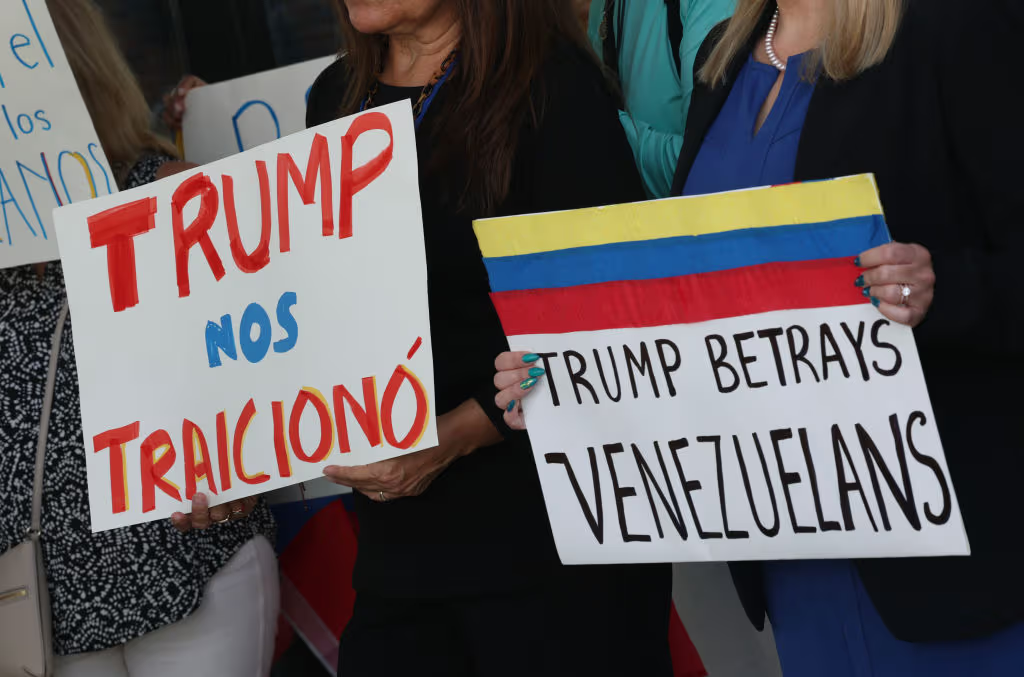
Attorneys representing a coalition of Venezuelan nationals and immigrant advocacy organizations have initiated the first federal lawsuit contesting the Trump administration’s decision to rescind Temporary Protected Status. Filed in a United States District Court in California, the complaint targets the Department of Homeland Security, its leadership under President Donald Trump, and Secretary Kristi Noem. The litigation arrives at a critical juncture, with numerous employment authorization documents tied to the program set to expire on April 2, prompting plaintiffs to seek an immediate judicial injunction.
The Legal Assault on DHS Policy
The forty-eight-page legal filing outlines a systematic challenge to the executive branch’s sudden policy reversal. Plaintiffs argue that the termination of the Venezuela TPS designation, originally established in 2023, constitutes an unlawful administrative action that disregards statutory requirements and procedural safeguards. The complaint specifically contends that the agency failed to provide adequate notice or a rational explanation for dismantling a protection framework that was recently expanded through automatic renewals under the previous administration.
Jessika Bansal, counsel affiliated with the National Day Laborer Organizing Network, emphasized the procedural irregularities at the heart of the case. She noted that the government effectively stripped away a guaranteed window of legal residency merely seventy-two hours after the new administration assumed control. Such rapid reversals typically trigger heightened scrutiny under the Administrative Procedure Act, which mandates reasoned decision-making and prohibits arbitrary policy shifts.
Constitutional and Statutory Grounds
Beyond procedural complaints, the lawsuit raises substantial constitutional concerns regarding the treatment of the Venezuelan community. The petition alleges that federal officials have adopted a racially charged narrative to justify mass deportations, thereby infringing upon equal protection guarantees embedded in the Fourteenth Amendment. Advocates assert that framing an entire nationality through a lens of criminality lacks evidentiary support and contradicts longstanding federal immigration principles.
The core of the statutory argument rests on the original criteria that justified granting TPS. Under federal law, the designation requires documented evidence of ongoing armed conflict, environmental degradation, or other extraordinary circumstances that prevent safe repatriation. The complaint highlights a glaring contradiction in the government’s own notices: while terminating protections, officials simultaneously acknowledged that conditions in Venezuela remain both extraordinary and temporary. Plaintiffs maintain that this admission inherently invalidates the rationale for revocation, as the foundational triggers for the status persist unchanged.
Human Cost Behind the Filings
Behind the legal terminology lie the lived experiences of eight Venezuelan nationals named as co-plaintiffs in the federal docket. Their testimonies underscore the tangible toll of abrupt policy shifts. Cecilia González, one of the named litigants, described the profound anxiety gripping her household as expiration dates approach. She warned that stripping away legal status forces families into immediate peril, leaving them exposed to removal proceedings in a nation where survival remains uncertain.
Adelys Ferro, executive director of the Venezuelan-American Caucus, reinforced the geopolitical reality driving the lawsuit. She stressed that structural instability, economic collapse, and democratic backsliding continue to dominate the Venezuelan landscape. According to Ferro, returning individuals would face insurmountable obstacles to securing basic necessities, let alone rebuilding lives in a fractured society. These firsthand accounts form the emotional and evidentiary backbone of the petition, illustrating how bureaucratic decisions translate into humanitarian crises.
Historical Precedent and Administrative Law Context
To understand the stakes of this litigation, observers must examine the broader trajectory of Temporary Protected Status within American immigration policy. Enacted through the Immigration Act of 1990, TPS serves as a humanitarian mechanism allowing nationals from designated countries to remain in the United States temporarily when return conditions pose severe threats. Historically, the program has shielded hundreds of thousands of individuals from conflicts in El Salvador, Haiti, Honduras, Syria, and Yemen, among others.
Legal scholars note that TPS designations operate on fixed cycles, requiring periodic reviews by the Secretary of Homeland Security. While administrations possess broad discretion to extend, modify, or terminate these programs, courts have consistently ruled that such actions cannot defy factual realities or bypass mandated comment periods. Past litigation surrounding TPS terminations has frequently resulted in preliminary injunctions when agencies failed to demonstrate that underlying crisis conditions had materially improved. This current filing mirrors those precedents, positioning itself within a well-established tradition of judicial oversight over executive immigration authority.
Immediate Stakes and Broader Implications
The April 2 deadline functions as both a tactical pressure point and a practical emergency. Thousands of Venezuelan TPS holders depend on associated work permits to sustain households and contribute to regional economies across multiple states. Should the court decline to intervene before that date, affected individuals could abruptly lose lawful employment authorization, triggering severe financial hardships and forcing employers into compliance dilemmas.
Furthermore, the ruling carries ramifications extending far beyond the Venezuelan diaspora. Immigration attorneys warn that aggressive revocations without substantive justification may embolden future executive actions targeting other protected populations. Civil rights organizations monitor the proceedings closely, viewing the decision as a measure of how rigorously federal judges will enforce administrative accountability. As briefing schedules advance, the legal community anticipates a thorough examination of statutory boundaries, executive discretion, and the balance between national directives and humanitarian obligations.
Source Reference (univision.com): Estatus de Protección Temporal
Frequently Asked Questions (FAQ)
What is the primary legal basis for challenging the TPS termination?
The lawsuit argues the termination violates the Administrative Procedure Act due to lack of reasoned explanation and ignores unchanged crisis conditions in Venezuela.
Why is April 2 a critical deadline in this case?
Many employment authorization documents issued under the Venezuelan TPS program expire on April 2, creating immediate urgency for judicial relief.
How does Temporary Protected Status historically function in U.S. law?
Established by the 1990 Immigration Act, TPS provides temporary humanitarian protection for nationals facing ongoing armed conflict, environmental disasters, or other extraordinary conditions preventing safe return.
{“@context”:”https://schema.org”,”@type”:”FAQPage”,”mainEntity”:[{“@type”:”Question”,”name”:”What is the primary legal basis for challenging the TPS termination?”,”acceptedAnswer”:{“@type”:”Answer”,”text”:”The lawsuit argues the termination violates the Administrative Procedure Act due to lack of reasoned explanation and ignores unchanged crisis conditions in Venezuela.”}},{“@type”:”Question”,”name”:”Why is April 2 a critical deadline in this case?”,”acceptedAnswer”:{“@type”:”Answer”,”text”:”Many employment authorization documents issued under the Venezuelan TPS program expire on April 2, creating immediate urgency for judicial relief.”}},{“@type”:”Question”,”name”:”How does Temporary Protected Status historically function in U.S. law?”,”acceptedAnswer”:{“@type”:”Answer”,”text”:”Established by the 1990 Immigration Act, TPS provides temporary humanitarian protection for nationals facing ongoing armed conflict, environmental disasters, or other extraordinary conditions preventing safe return.”}}]}